
Before You Sell Your Practice: The Essential Checklist for Healthcare Exits
Contributors



The phone rings. It is a private equity firm, a dental service organization or a hospital system making an unsolicited offer for your medical or dental practice.
You weren’t planning to sell, but the number they mention makes you pause.
This scenario is becoming all too common as healthcare continues to consolidate. According to the United States Government Accountability Office, at least 47% of physicians were consolidated with hospital systems in 2024, up from less than 30% in 2012. The Private Equity Stakeholder Project (PESP) identified 1,049 private equity-backed healthcare deals in 2024 alone. Buyers across all specialties are actively calling practice owners.
Here’s the thing: Most healthcare practice owners are not prepared for this moment, and it could cost them millions.
This guide explains how to get “sale-ready” so you can negotiate from strength (whether you sell tomorrow or years from now). This is not about planning to exit. It is about being informed, confident and in control when an opportunity shows up unexpectedly.
The Preparation Timeline: What Does a Sale-Ready Medical or Dental Practice Look Like?
The ideal preparation follows a two- to three-year roadmap.
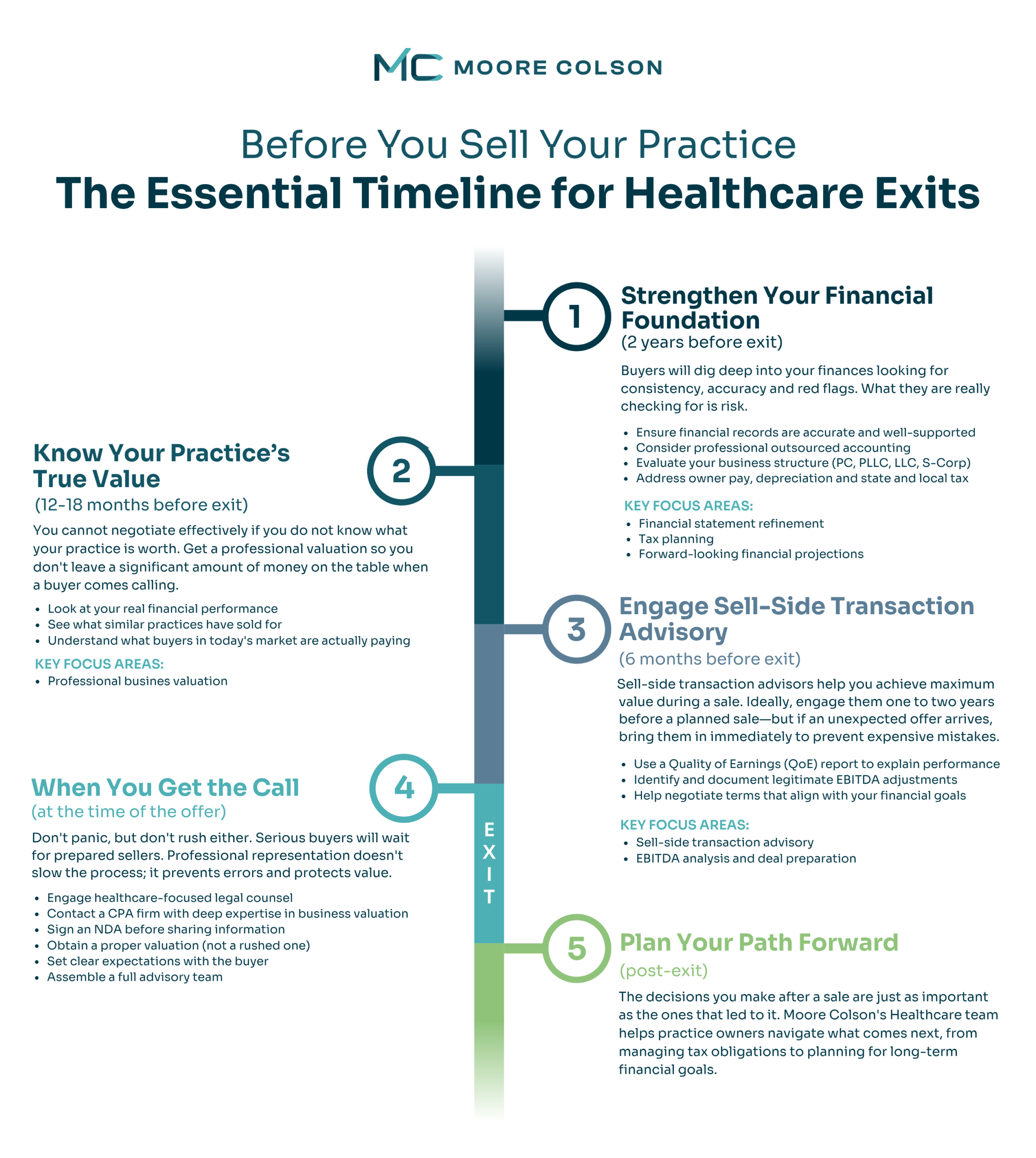
2 years out: Clean, accurate, consistent financials
12–18 months out: Professional business valuation
6 months out: Sell-side transaction advisory, EBITDA analysis and deal preparation
If you are not on this timeline, start now. Every step you take potentially increases value and potentially reduces risk.
Step 1: Strengthen Your Financial Foundation
Elevate Your Financial Reporting
Buyers will conduct a detailed review of your financial information, including financial statements, tax returns and revenue records, to assess consistency, accuracy and any potential red flags. Ultimately, they are evaluating the level of risk associated with the business, and disorganized or unreliable financial records can signal increased risk and negatively impact valuation or deal confidence.
Sound Financial Reports Represent:
- Accurate and trustworthy financial data
- Better cash flow visibility and forecasting
- Ability to make more informed business decisions
- Reduced risk of audit findings, tax issues or financial misstatements
- Greater confidence in budgets, projections and key performance indicators (KPIs)
Consider Professional Outsourced Accounting
Many practices rely on basic bookkeeping or manage their accounting internally. While this may be sufficient for day-to-day operations, it often does not produce the level of financial reporting that sophisticated buyers expect during a transaction review.
Outsourced accounting provides:
- Accurate and well-supported financial records that reduce buyer concerns about risk or adjustments.
- Clean, buyer-ready financial statements that improve credibility during due diligence.
- Consistent monthly close process that demonstrates financial discipline and operational maturity.
- Improved earnings quality (EBITDA reliability) by ensuring revenue and expenses are properly recorded and normalized.
- Stronger valuation support and fewer deal surprises, helping reduce price reductions, holdbacks or extended negotiations.
Professional accounting practices signal strong management, which can positively impact business valuation.
Optimize Your Tax Structure
Your tax strategy can make a huge difference in what you actually take home from a sale. How your medical or dental practice is set up, how you pay yourself and potential tax issues all affect your bottom line.
Key things to think about:
- Whether your business structure (PC, PLLC, LLC, S-Corp) is best for your taxes
- How owner pay is handled
- Potential tax hits from depreciation or capital gains
- State and local tax issues
Tax planning must happen before the sale, not during it.
Once you’ve agreed to terms, your options for saving on taxes are very limited. Work with advisors who know healthcare practice sales and understand the specific tax issues that come with selling a medical or dental practice.
Step 2: Know Your Practice’s True Value
You cannot negotiate effectively if you do not know what your practice is worth.
Why Professional Valuation is Essential
A professional valuation gives you a realistic, market-based picture of what your practice is actually worth. Instead of relying on shortcuts or “rules of thumb,” it looks at your real financial performance, what similar practices have sold for and what buyers in today’s market are paying.
In 2023, when I analyzed 46 dental practice valuations, the difference was striking.
The common rule of thumb: valuing a practice at 60–80% of revenue undervalued 41 out of 46 practices. More than half were undervalued by at least $1 million.
The same thing happened when comparing EBITDA (Earnings Before Interest, Taxes, Depreciation and Amortization) multiples. Many owners assume practices sell for 3–4 times EBITDA, but none of the practices I reviewed were valued that low. Actual values were, on average, about $3 million higher than what the rule-of-thumb math predicted, more than double in many cases.
In short: quick formulas are easy, but they’re often inaccurate. A professional valuation helps ensure you don’t leave a significant amount of money on the table when a buyer comes calling.
Step 3: Engage Sell-Side Transaction Advisory Services
If a valuation tells you what your practice is worth, sell-side transaction advisors help you to be prepared and achieve maximum value during a sale. Ideally, owners begin to engage advisors one to two years before a planned sale. But if an unexpected offer arrives, bringing them in immediately can prevent expensive mistakes. Here’s what these advisors do:
Make Sense of Historical Performance
Transaction advisory services through a Quality of Earnings (QoE) report explain revenue fluctuations, expense spikes and other anomalies that could concern buyers by providing a historical adjusted EBITDA analysis. Clear explanations help you control the narrative while maintaining buyer confidence in the underlying performance of the business.
Present EBITDA the Right Way
This is the most critical part of maximizing sale price.
EBITDA often forms the basis of valuation in healthcare acquisitions. Advisors help you identify legitimate adjustments, such as owner compensation outside market norms or one-time expenses and properly document them. These adjustments can potentially dramatically increase your EBITDA, which directly affects purchase price, as adjusted EBITDA will be needed to determine the final transaction price.
Even modest improvements to EBITDA can yield significant gains in valuation and ultimately seller proceeds.
Prepare Buyer-Ready Financials
Buyers expect financial information to be presented in specific formats. Advisors will prepare carve-out statements if your practice is part of a larger entity, or financial narratives explaining operations, reducing time and effort spent during buyer due diligence.
Build Credible Forecasts
Buyers pay for future cash flows, not past performance. Transaction advisors help evaluate projections, bridge past performance to future forecasts and create credible growth models that justify valuation.
Structure the Deal to Maximize Your Net Proceeds
Even when two deals have an identical purchase price, the tax consequences can be dramatically different. Advisors analyze transaction structures, model the net after-tax outcome and help negotiate terms that align with your financial goals. Inefficient structuring can easily cost six or seven figures; expert guidance helps protect your proceeds.
What to Do When You Actually Get the Call
Let’s return to our opening scenario. The phone rings with an unexpected offer. What do you do?
If You’re Prepared:
- You have leverage and confidence in negotiations
- You know your practice’s true value
- Your financials are ready for due diligence
- You have trusted advisors in place
- You can evaluate the offer objectively against your valuation
- You can negotiate from strength
If You’re Not Prepared
Don’t panic, but don’t rush either. Serious buyers will wait for prepared sellers, understanding that proper preparation benefits everyone involved.
Take these steps immediately:
- Engage healthcare-focused legal counsel
- Contact a CPA firm with deep expertise in business valuation
- Sign an NDA before sharing information
- Begin organizing financials
- Obtain a proper valuation (not a rushed one)
- Set clear expectations with the buyer
- Assemble a full advisory team
Professional representation doesn’t slow the process; it prevents errors and protects value.
The Cost of Being Unprepared
Owners who enter negotiations without preparation often run into lower offers, stressful due diligence, tax surprises and deals that fall apart late in the process.
More importantly, they may never know how much value they unintentionally gave away.
On the other hand, becoming sale-ready helps you run a stronger business, even if you never sell. Clean financials, clear valuations and thoughtful planning support better decisions, improved profitability and long-term stability.
Planning Your Path Forward
Whether you’re planning for a healthcare exit in the next few years or simply want to be prepared when an offer comes, now is the right time to start.
Moore Colson’s Healthcare team helps medical and dental practice owners strengthen their operations, understand their value and navigate the full sale process, from preparation through closing.
About the Author
Tom Brooks, CPA, ABV, ASA, is a Partner in Moore Colson’s Business and Financial Advisory Practice Area with more than 30 years of experience. He assists public and privately held companies with valuation and litigation support.
Disclaimer: This content is provided for informational purposes only and reflects information available as of the date of publication. It does not constitute legal, tax, accounting, or other professional advice. Please consult a qualified professional before taking action based on this content.