
Before You Sell Your Business, Ask Yourself These 7 Questions
Contributors



Summary: Selling a business is one of the biggest financial events most owners will ever go through, and the preparation that happens before a buyer shows up often matters more than the negotiation itself. Moore Colson Partner and Transaction Advisory Practice Area Leader Christopher D. Fagan shares the financial due diligence, tax planning and quality of earnings (QofE) work that can make or break a business exit strategy and explains why the sellers who start early almost always come out ahead.
You’ve spent years, maybe decades, building a business. You’ve made payroll through tough stretches, navigated market shifts and kept clients coming back. By the time a sale starts feeling like a real possibility, there’s a natural confidence that comes with that. You know your business better than anyone.
And that’s exactly what makes the preparation so easy to overlook.
When I work with business owners who are thinking about a sale, one of the most important things I do is help them see their business the way a buyer will. Not the way they’ve lived it, but the way someone writing a very large check is going to evaluate it. That shift in perspective is the foundation of capital market readiness, and getting there early makes a meaningful difference in what you walk away with.
1. When Is the Right Time to Start Preparing Your Business for Sale?
I think about this work in terms of three foundations. All three have to be solid for the deal to hold up.
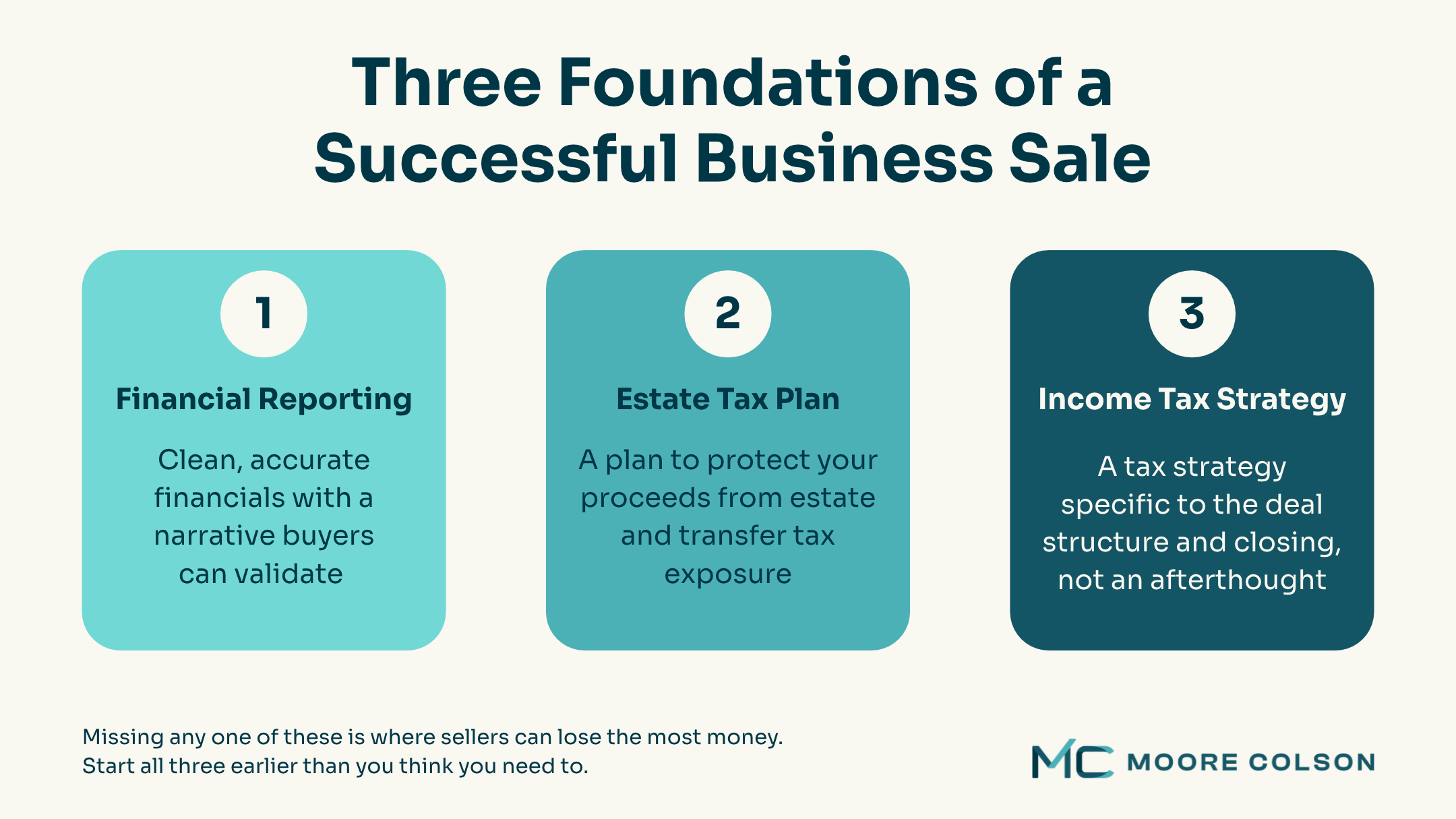
The first is clean, accurate financial reporting with a story around it that’s defensible. The second is a well-developed estate tax plan. The third is an income tax strategy specific to the closing.
Most sellers arrive with one or two of these in reasonable shape. Far fewer arrive with all three. And there are really only two places you lose the most money in a transaction: poor financial preparation that suppresses your valuation, and inadequate tax planning that routes too much of your proceeds to the federal government. Both are avoidable. But they require a head start.
2. Could Your Financials Be Optimized for the Wrong Goal?
This one surprises a lot of people. The financial statements you’ve been using to run your business are built to minimize your tax liability. That’s smart tax management. But when you go to sell, those same statements can work against you, because minimizing income and maximizing valuation are opposite goals.
Most private company financials are prepared to show as little income as possible. A sale requires you to show as much as possible. So part of the work we do is helping sellers unwind tax positions that have been baked into their numbers for years and identify levers in the business that can drive real value to the bottom line. Things like renegotiated supplier contracts, changes to how certain costs are classified or operational adjustments that have been on the list but never prioritized. These aren’t tricks. They’re just things that become visible when someone is looking at your business through a buyer’s lens for the first time.
3. What Are Buyers Actually Finding When They Dig In?
One of the most common issues we see is owners underestimating how certain normal accounting treatments look to a buyer. Here’s a straightforward example: say you wrote off a $100,000 accounts receivable this year from a sale that happened two years ago. From a GAAP perspective, that’s entirely appropriate. But when you’re trying to show a buyer what your forward-looking cash flows look like, that write-off creates drag in the wrong period. We’d push that cost back to where it belongs, and suddenly there’s $100,000 of income that wasn’t visible before.
It’s a little like proofreading your own writing. You’ve lived inside these numbers for so long that small inconsistencies, margin trends that don’t quite add up or one-time items in the wrong period just don’t jump out. A fresh set of eyes will find them. The important question is whether it’s your advisors who find them first, or the buyer.
Because once a buyer finds something that doesn’t hold up, the dynamic of the whole deal shifts. They price in more risk, they dig in harder and you spend the rest of the process defending your numbers rather than standing behind them. You want to be the one presenting a clean, well-supported story, not reacting to someone else’s questions about it.
4. Why Does a Quality of Earnings (QofE) Analysis Matter When Selling Your Business?
A quality of earnings (QofE) analysis is one of the most valuable things a seller can invest in before going to market, and it’s often misunderstood. It’s not just about making your numbers look better, though in most cases, Adjusted EBITDA goes up. It’s about getting an independent, validated picture of what your business is actually worth before you’re emotionally committed to a number that may or may not hold up under scrutiny.
There are times when a QofE analysis reveals that EBITDA is lower than the owner expected. That’s not a bad outcome. It’s clarity, before you’re deep in a process with a buyer who has already started pricing that gap in their favor. It also often surfaces operational recommendations that, if addressed over the following year or two, can meaningfully increase value. Some clients use that information to regroup before going to market. Others have circumstances that make timing non-negotiable and proceed anyway, just with realistic expectations. Either way, knowing is worth far more than finding out too late.
5. What Are Middle Market Buyers Really Looking For?
There’s a common assumption that buyers are running your business through a sophisticated KPI benchmarking model. In middle market deals, that’s usually not how it works. The public data available for benchmarking is mostly built on larger companies and doesn’t always translate down to privately held businesses.
What buyers are actually looking for is simpler and harder to fake: good recurring cash flows, a stable management team and a customer base that isn’t dangerously concentrated. If 50% of your revenue comes from one customer, that’s a significant risk factor in a buyer’s eyes, regardless of how strong that relationship feels to you. They’re also betting, whether explicitly or not, that they can professionalize the business and improve efficiency, often by combining it with other businesses through a roll-up strategy.
The number they’re anchoring to is Adjusted EBITDA, which serves as a proxy for free cash flow. They want to understand how much equity they’ll need to put in versus how much they can finance, and whether the working capital needs of the business can sustain itself without additional capital infusions post-close.
6. Are You Letting Buyers Control Your Exit Timeline?
Perhaps the most consistent mistake I see sellers make is letting a buyer dictate the pace of the process. A buyer approaches, shares an exciting number and then creates urgency. If you don’t move fast, the deal is going to disappear. It’s a very effective tactic because it feels real.
But it almost never is.
In all my years doing this, I’ve never seen a buyer walk away from a good asset because a seller wanted more time to get their documentation in order. If your business is worth buying, it’s worth the buyer waiting. If anything, a well-prepared seller makes the process smoother for everyone. The buyer’s advisors have less to work through, the valuation is less likely to shift late in the process and the deal is more likely to close.
The sellers who do the best are almost always the ones who resist that urgency, take the time to get their foundations in place and run a competitive process with multiple buyers rather than a single exclusive conversation. Competitive tension works in your favor. One buyer with no alternatives does not.
7. Have You Thought About What Comes Next?
There’s a dimension to this that doesn’t get enough attention: what life looks like after the sale. According to the Exit Planning Institute, “75% of business owners ‘profoundly regret’ selling their business within one year after selling.”
The deal goes fine. The money arrives. And then the structure and identity that running a business provided just isn’t there anymore.
This is part of what a good advisory team helps you think through before you close, not just the mechanics of the transaction, but what you’re actually trying to accomplish with the proceeds and how you plan to spend your time going forward. Your wealth advisor should be part of that conversation well before closing, ideally someone with experience working with owners who have gone through significant liquidity events.
The right team for this process includes an M&A-focused attorney, a transaction-experienced accountant, an investment banker or business broker, and a wealth advisor. It’s an investment, and sellers who try to minimize those costs almost always pay more in the form of suppressed valuation, deal complications or tax inefficiency than they would have spent on the professionals to prevent those things.
Your Next Chapter
You’ve built something worth protecting. The goal is to get everything you’ve earned out of it. If you’re thinking about a sale in the next one to three years, the Moore Colson Transaction Advisory team can help you assess where you stand, identify what needs attention and build the foundation for a successful exit.
FAQ
How do you price a business for sale?
Most buyers in the middle market use a multiple of Adjusted EBITDA to determine what a business is worth. That multiple varies by industry, company size and market conditions, which is why the quality of your financial reporting directly affects your valuation. A sell-side quality of earnings analysis can help you understand your true Adjusted EBITDA before a buyer runs their own numbers.
How long does it take to sell a business?
The process typically takes six months to over a year from preparation to close, depending on how organized your financials are, how many buyers you engage and how complex the deal structure becomes. Sellers who invest in preparation upfront (clean reporting, a QofE analysis and a transaction tax strategy) tend to move through due diligence faster and are less likely to see a deal fall apart late in the process.
How can you minimize taxes when selling a business?
Tax planning for a business sale should start well before a deal is on the table. The two biggest areas where sellers lose money are income tax on the transaction itself and estate tax exposure on the proceeds. Strategies vary depending on the deal structure, but working with a transaction-experienced accountant early gives you more options and helps you retain significantly more of what you’ve earned.
How much is my business worth?
That depends on your Adjusted EBITDA, the strength of your recurring cash flows, the stability of your management team and how concentrated your customer base is. A quality of earnings analysis gives you an independent, validated answer before you enter a process with a buyer who will run their own evaluation. In some cases, the analysis also surfaces operational improvements that can increase value if you have time to address them before going to market.
What does a business owner need to know before selling?
The biggest misconception is that the financials you use to run your business are the same ones a buyer wants to see. Most private company financials are built to minimize taxable income, but a sale requires showing as much income as possible. Beyond the numbers, sellers should understand how buyers evaluate risk, why a competitive process with multiple buyers produces stronger outcomes and why planning for life after the sale deserves just as much attention as the deal itself.
About the Author
Christopher D. Fagan, CPA, is a Partner and the Transaction Advisory Practice Area Leader at Moore Colson. He advises private equity platforms and founder-owned businesses on acquisitions and ownership transitions.
Disclaimer: This content is provided for informational purposes only and reflects information available as of the date of publication. It does not constitute legal, tax, accounting, or other professional advice. Please consult a qualified professional before taking action based on this content.