
Inside the 2027 Tax Brackets, Standard Deduction and Gift Limits
The IRS has released the 2027 tax brackets, standard deduction amounts and inflation adjustments for almost 70 other tax provisions in Revenue Procedure 2026-35. These annual changes reach a wide range of provisions, from income tax rates to credits and gift limits.
Take these 2027 amounts into consideration as you implement year-end tax planning strategies for 2026 and prepare for the coming year.
2027 Federal Income Tax Brackets by Filing Status
Tax-bracket thresholds increase for each filing status, but because they’re based on percentages, they increase more significantly for the higher brackets. For example, the top of the 10% bracket will increase by $400 to $800, depending on filing status, but the top of the 35% bracket will increase by $12,475 to $24,950, depending on filing status.
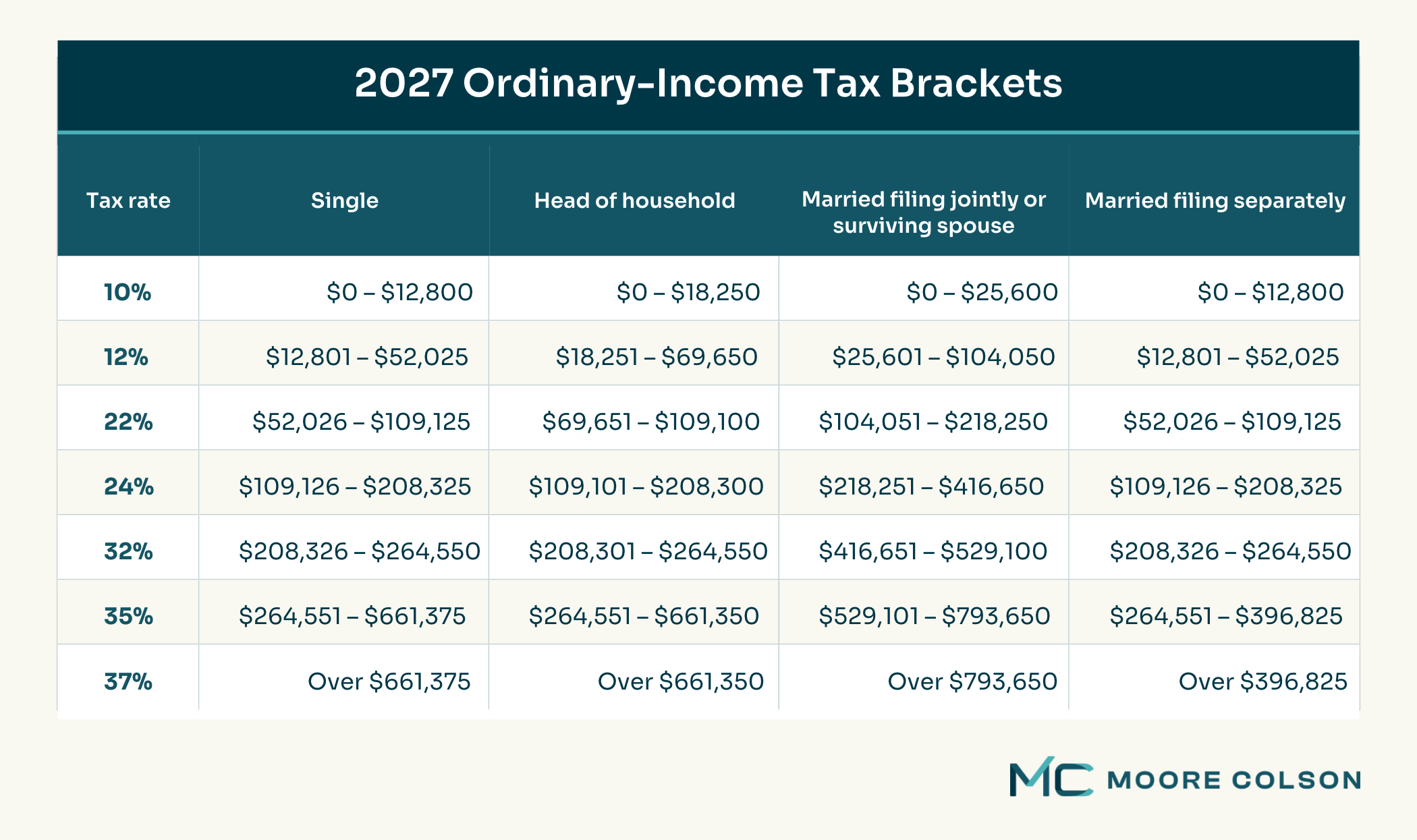
Last year’s One Big Beautiful Bill Act (OBBBA) made the rates permanent. The income tax brackets will continue to be annually indexed for inflation.
How Much Is the 2027 Standard Deduction?
The OBBBA made permanent the approximate doubling of the standard deduction amount for each filing status that went into effect back in 2018. The amounts will continue to be annually adjusted for inflation.
In 2027, the standard deduction will be $33,200 for married couples filing jointly, $24,925 for heads of households and $16,600 for single filers and married taxpayers filing separately. These are increases of $1,000, $775 and $500, respectively.
2027 Long-Term Capital Gains Tax Brackets
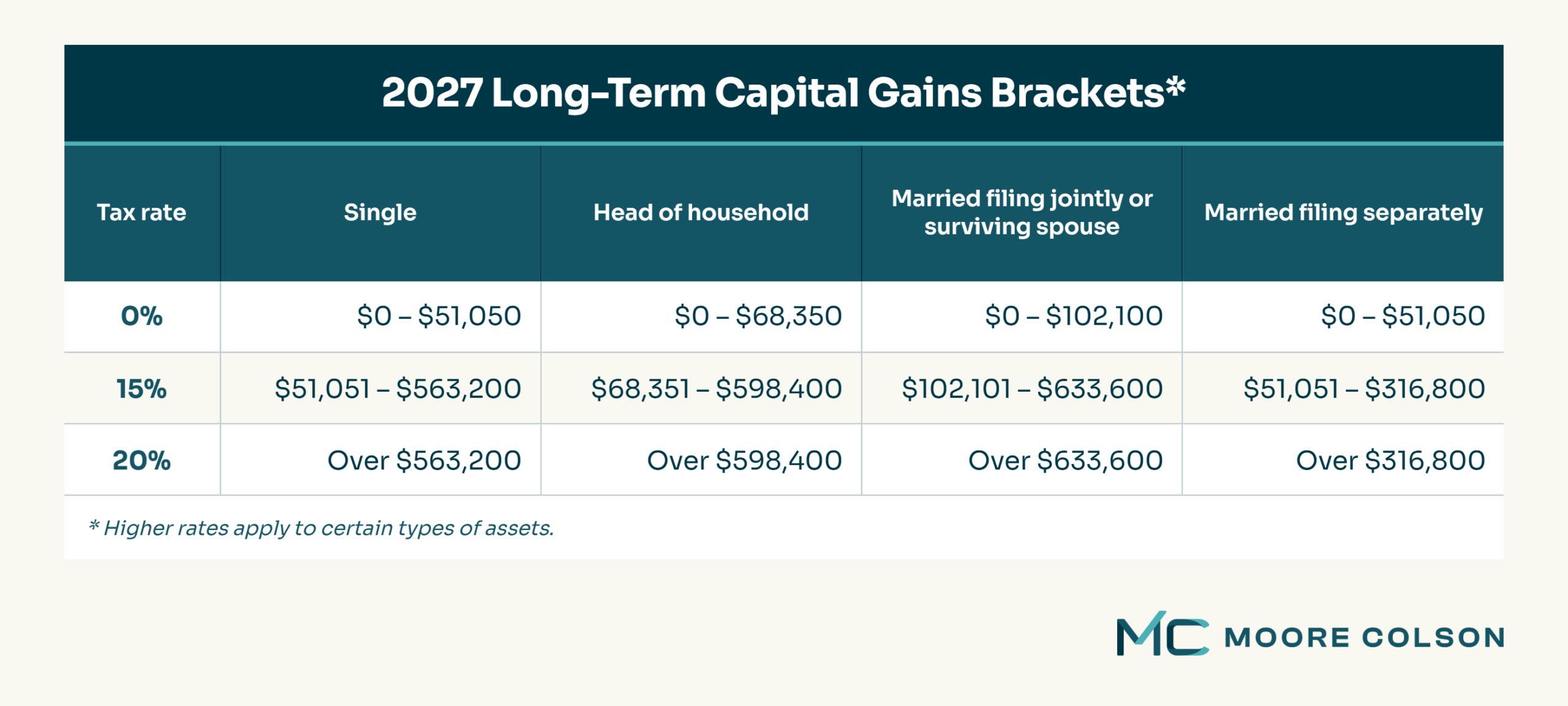
The long-term gains rate applies to realized gains on investments held for more than 12 months. For most types of assets, the rate is 0%, 15% or 20%, depending on your income. While the 0% rate applies to most income that would be taxed at 12% or less based on the taxpayer’s ordinary-income rate, the top long-term gains rate of 20% kicks in well before the top ordinary-income rate does.
2027 AMT Tax Brackets and Exemption Amounts
The alternative minimum tax (AMT) is a separate tax system that limits some deductions, doesn’t permit others and treats certain income items differently. If your AMT liability exceeds your regular tax liability, you must pay the AMT.
The AMT brackets are indexed for inflation each year, just like the regular tax brackets. In 2027, the threshold for the 28% bracket will increase by $8,000 for all filing statuses except married filing separately, which will increase by half that amount.
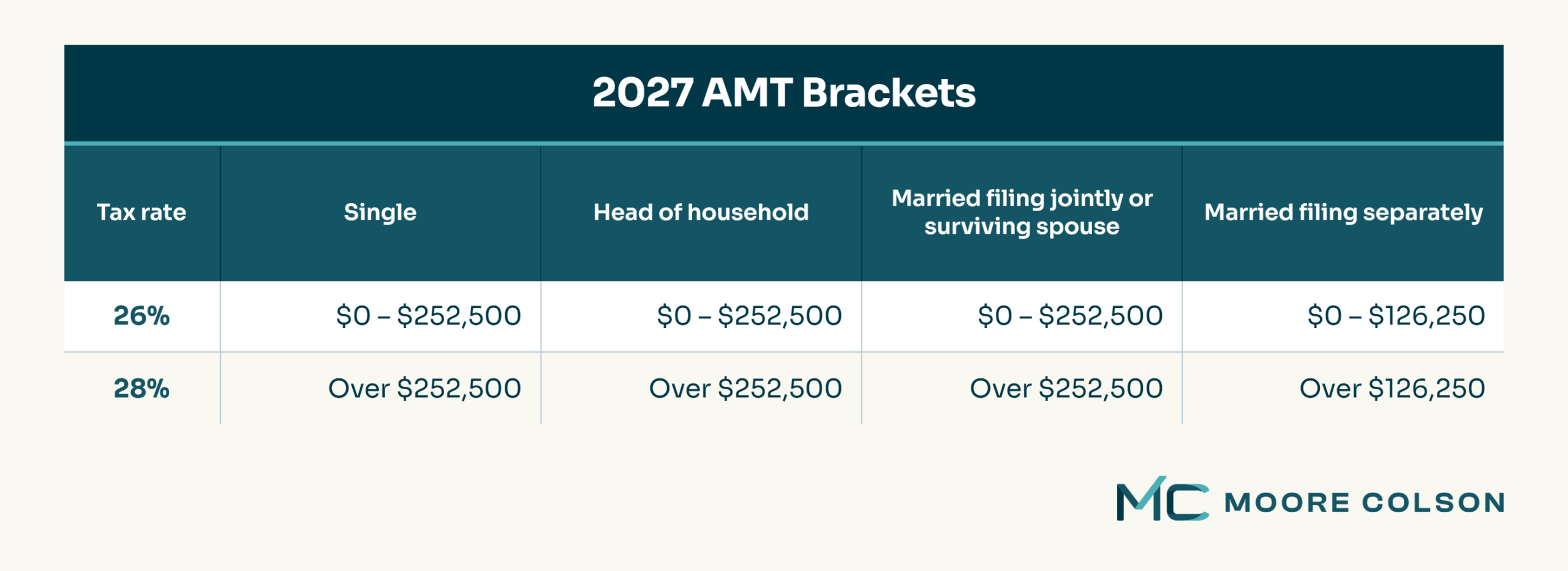
The OBBBA made the AMT exemption amounts permanent, and the amounts continue to be indexed for inflation. The exemption amounts in 2027 will be $93,000 for singles and heads of households, $144,700 for joint filers and $72,350 for separate filers, increasing by $2,900, $4,500 and $2,250, respectively, over 2026 amounts.
The AMT exemption phases out over certain income ranges. It’s completely phased out if AMT income exceeds the top of the applicable range. The exemption phaseout ranges in 2027 will be $515,950 to $701,950 for singles and heads of households and $1,031,900 to $1,321,300 for joint filers. Amounts for married couples filing separately are half of those for joint filers.
Child Tax Credit and Adoption Credit Amounts for 2027
Certain child-related breaks are adjusted for inflation each year but don’t necessarily increase annually. These breaks are also limited based on a taxpayer’s modified adjusted gross income (MAGI). Taxpayers whose MAGIs are within an applicable phaseout range are eligible for a partial break, and breaks are eliminated for those whose MAGIs exceed the top of the range.
Here are the 2027 figures for two important child-related breaks:
The Child Tax Credit. The OBBBA made this credit permanent and adjusts it annually for inflation. For 2027, the credit increases by $100 to $2,300.
The OBBBA also made permanent the annual inflation adjustments to the limit on the refundable portion of the credit. For 2027, the refundable portion increases by $100 to $1,800.
Keep in mind that the Child Tax Credit phases out for higher-income taxpayers, and its phaseout thresholds aren’t inflation-indexed Under the OBBBA, they’re permanently $200,000 for singles and heads of households and $400,000 for joint filers.
The Adoption Tax Credit. The maximum credit will increase by $580, to $18,250 in 2027. Under the OBBBA, a portion of the credit is refundable, and that portion is annually indexed. For 2027, the refundable portion is $5,280 (up from $5,120 for 2026).
The MAGI phaseout range for eligible taxpayers adopting a child will increase by $8,600 in 2027. It will be $273,680 to $313,680 for joint, head of household and single filers.
2027 Gift Tax Exclusion and Estate Tax Exemption
Both the unified gift and estate tax exemption and the generation-skipping transfer tax exemption are adjusted for inflation each year. In 2027, the amount will be $15.48 million (up from $15 million in 2026).
The gift tax annual exclusion increases by $1,000, to $20,000 per giver per recipient in 2027.
Using the 2027 Inflation Adjustments in Your Tax Planning
The impact of the 2027 inflation adjustments will vary based on taxpayers’ individual circumstances. Understanding how these changes affect your tax situation is essential to identifying potential tax-saving opportunities. The Moore Colson Tax team can help you review how these changes apply to your situation and build a strategy for the rest of 2026 and into 2027.
Disclaimer: This content is provided for informational purposes only and reflects information available as of the date of publication. It does not constitute legal, tax, accounting, or other professional advice. Please consult a qualified professional before taking action based on this content.